
“He was the only person who ever really saw who I was!”
Earthquake Bird, (2019)
EarthQuake Bird is a tale of denial- interwoven with an exploration of anger & guilt, belonging vs. isolation -set in the background of 1989 Tokyo, Japan.
Lets start with some fast facts:
- EarthQuake Bird is adapted from the 2001 book by Susanna Jones.
- The movie was directed by Wash Westmoreland (also known for Colette, 2018 and Still Alice, 2014).
- It stars Alicia Vikander (Tomb Raider, 2018 and Ex-Machina, 2014), Riley Keough (Mad Max: Fury Road, 2015) and Naoki Kobayashi.
- Available on Netflix.
To be honest, I have not read any reviews or interpretations of the film. I ended up watching it twice in one day and then writing this word vomit. I found it to be a beautiful film. It dealt with the themes of anger and guilt in interesting ways, told in flashbacks before finally ending in the present. Warning: Many spoilers ahead.
Lets start with an overview of the plot before our deep dive. The main character is Lucy Fly (Alicia Vikander), originally from Sweden, who has been living in Japan for the last 5 years and 2 months (she was very specific-that’s one thing about this character-language and specificity are important to her). She is fluent in the Japanese and has really done her best to integrate herself into the culture. The film starts with the police taking her in for questioning due to her possible connection to a body found in the river. The suspected victim is Lily Bridges (Riley Keough). Through flashbacks, as she relays her story to the two detectives interviewing her, we learn the story of Lucy, Teiji (Naoki Kobayashi), and Lily and the events leading up to Lily’s disappearance.
This film, to me, has a very Hitchcock-esque vibe to it. The first thing we hear is a soft, but driving melody. It’s purposeful and repeated and yet within it’s structure-it promises mystery. The first shot is three trains converging from different directions. Our first introduction to Lucy is on one of these trains. She is the only Caucasian person and easy to spot. As she walks through the city she has a blank expression on her face. We will see that deteriorate throughout the film.
She passes a missing person sign. The poster shows a woman with fiery, wild red hair and red lips-a small smile gracing her face. Enter Lily Bridges. We see Lucy go about her day working as a translator at a company where she watches and translates movies? TV shows? Her friend, Natsuko (Kiki Sukezane) tells her about the body found and thus we are onto the police escorting her in for questioning.
At the start of the interview, the police underestimate her. She corrects their assumption that she does not speak the language. As I mentioned above, language is an important tool in this film. The characters go back and forth between English and Japanese. Lucy clings to the Japanese language , in a way it is a part of her identity and her sense of belonging(I’ll leave the dissection of cultural appropriation to someone else), but it is also used for a good portion of the film, as a sense of superiority over Lily, a nurse from America who has come to Japan for a change. She does not know the language and comes to rely on Lucy to help her navigate the new territory. Lucy speaks the language with ease. She feels comfortable in the culture. She feels like she belongs after a lifetime of isolation and separation from her family (for reasons at this time unknown to the audience).
We learn how strongly she ties her sense of belonging with the Japanese culture when during the interview, the younger detective angrily remarks, “You are not like Japanese women!”
Lucy vehemently responds, “Yes I am!”
The story truly begins with its first flashback. It is preceded by the detective questioning if she had a boyfriend. Her response is no. We are then transported back in time, Lucy is walking down the street, it’s a sunny day and there is a subtle shift in her demeanor. She is lighter, more carefree. She spots a man photographing a puddle and as she passes him, he photographs her. She confronts him and eventually asks him, “Don’t people get annoyed?” To which he responds…
“I don’t photograph people.”
“What do you take pictures of then?”
“Water. Buildings. Reflections. That kind of thing.”
Enter Teiji Matsuda. A calm, cool, collected man who works in a noodle shop and spends his free time doing photography. He is tall, dark, and handsome and its easy to see why Lucy is attracted to him. But for me, this is the first and main piece of foreshadowing in the movie.
He is blunt and as they head to the said noodle shop, we see that bluntness in action. He questions her motives when she tries to make “normal conversation”. Here comes the second big hint and a key insight into Teiji’s personality and his, I’ll say it, misconception of Lucy.
Lucy: “Just trying to make conversation.”
Teiji: “Why?”
Lucy: “Because that’s what normal people do.”
Teiji: “But you’re not normal.”
Lucy: “Neither are you.”
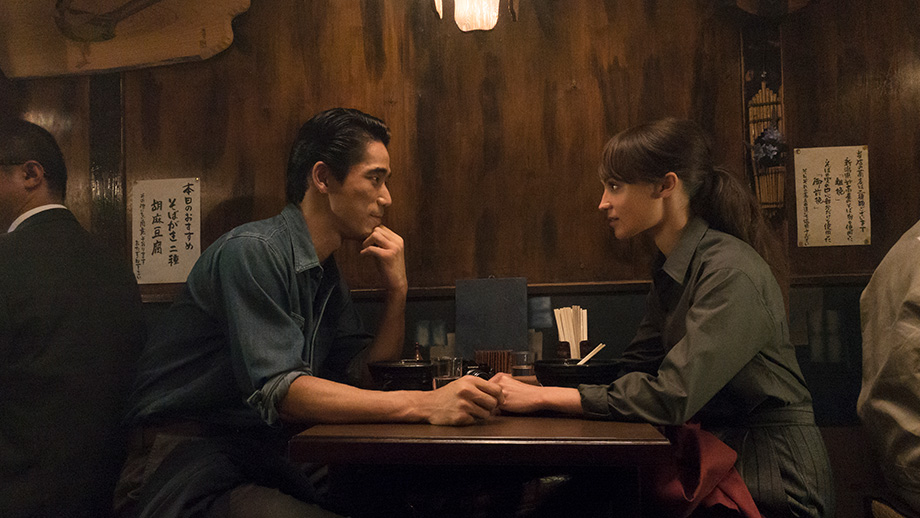
Despite vocalizing the fact that he’s a stranger that she just met, she goes home with him to be photographed. Why? “Because I’m attracted to you.” He takes her to an industrial area on the water where he has a photography studio in one of the old buildings. He dares her to be honest, she is intrigued. Just as she is about to close the distance, there is an earth quake. They take shelter in a large locker and just like that it’s over.
There’s a faint whistling noise in the distance, Teiji asks if Lucy hears it and he comments “Only after earthquakes, you hear it.”
She asks what it is.
He doesn’t respond.
That’s a behavior that you see more apparent about Teiji as the story continues. He is asked a question and he simply does not respond and is rarely challenged. Later in the film, Lily and Lucy are woken up by an earthquake and Lucy retells the phenomena of the “Earthquake Bird”, a phenomena that Teiji never named. It’s almost as if Lucy believes its a mythical creature that reveals itself after earth quakes and perhaps not the distant sound of sirens.
It brings about another theme in the film-distorted reality related to denial and trauma. As the film progresses-we see Lucy’s sense of reality challenged as she suffers from brief hallucinations.
After the first earth quake, we see Lucy and Teiji’s relationship develop. Parallel to this we meet Lily. Lily is friendly, talkative, and perhaps somewhat overly familiar. She at first, appears a helpless character. Lucy reluctantly helps her find an apartment and begins to teach her the very basics of the language, but she confronts Lily on the need to learn it herself.
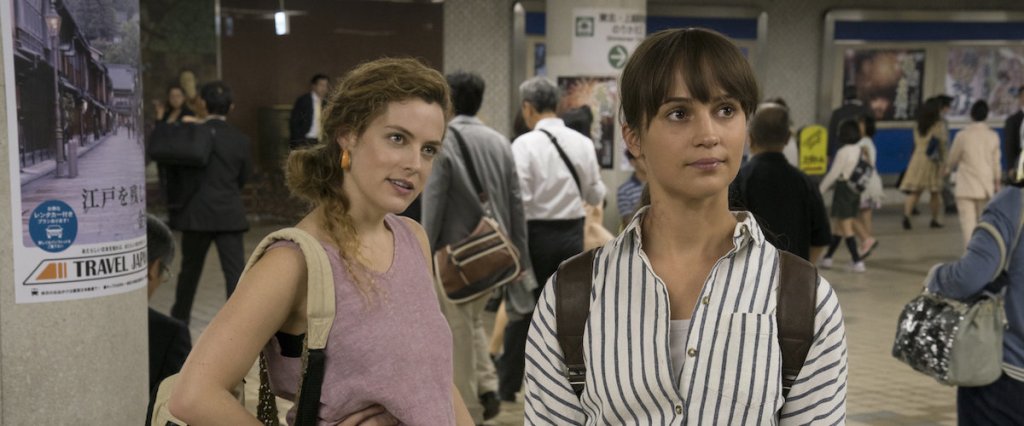
Trouble brews when Lucy’s friend, Yamamoto, (a member of the string quartet Lucy plays in) slips and falls down the stairs just as Lucy is about to greet her. In the midst of this tragedy, we truly see how muted Lucy’s emotions are. Yet, there is still a difference between her emotion’s being muted and Teiji’s emotions being blunted. Both characters are withdrawn socially and reserved in conversation. Despite Lucy’s desire for sexual intimacy, Teiji doesn’t consent and initiate until Lucy discloses the accident to him.
Lucy: “Death follows me. It always has.”
Teiji: “I understand…you will tell me in time and I will tell you things about me.”
At this point he unlocks a cabinet full of manila file folders. The majority are the typical color, but interspersed throughout are three to four blue file folders. He pulls one out and shows her the pictures. Somewhat creepy, they are pictures of his deceased Aunt (who raised him) in a coffin, her hands clasped as if in prayer and her face serene. Lucy remarks that she is beautiful. Teiji says “We live in the atmosphere of death, but we are alive.”
Aaaaaand queue sex scene. Whats more important than the sex scene?
The nature of the relationship after. Lucy is happy, shes making attempts to cuddle and continue the intimacy. Teiji is solely focused on the pictures, it’s always the pictures.
Teiji: “The subject always gives some part of themselves to the photographer. If every time I took a photo, it took a piece of your soul, would you still let me?”
Lucy: “I think you know the answer to that question.”
This is also one of the first points in the film where as key scenes occur, we see brief flashbacks to Lucy’s past. As time goes on, the memory unfolds.
It serves as a tool used to show Lucy being forced to remember traumatic events of her childhood as she deals with present stressors. Throughout the movie we see Lily become more interested in Teiji and Teiji reciprocating Lily’s advances. Slowly we start to see Lucy assert herself as the anger and frustration builds.
What’s fascinating about this dynamic is that as Lily starts expressing interest in Teiji, she pushes Lucy on questions about Teiji that Lucy never asked.
Lucy: “Why are you taking them?”
Teiji: “I’m collecting them.”
Lucy: “For what?”
Teiji: “For my collection.”
Insert eye roll gif.,
(I’m trying to keep this blog classy otherwise I would)
In the next scene, she lets herself into his studio and breaks into his file cabinet, taking out one of the blue folders.
Inside are pictures of another girl, Sachi. The photos are chilling. As Lucy flips through them, Sachi goes from smiling and happy to withdrawn and somber. The music and tension builds and before we can see the last image, Teiji arrives back and confronts Lucy. She asks about Sachi and per Teiji, “I don’t know. Shes gone.”
“Just gone?”
“We finished. She left. I didn’t try to find her. When I found you, I stopped thinking about Senchi.”
This is what I love about the movie. Even as audience members we are in a state of denial. At this point, there are two ways to interpret Teiji. There was a break up and he moved on. Or perhaps something nefarious happened to Senchi. Either way, we never see that last picture.
This is the question that must be asked throughout the film.
Teiji himself at the beginning of the movie stated, “I don’t photograph people.”
Can more be read into that statement? How does Teiji view people? Are they more than objects to him?
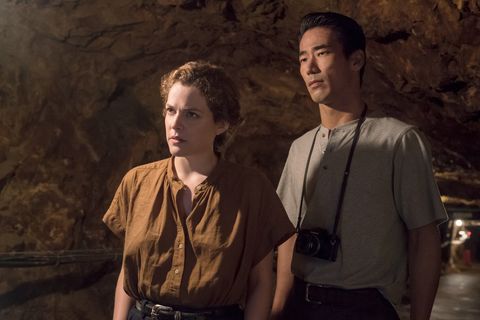
Teiji is very good at evading questions and we never truly learn the answer.
Anyway, so Lucy, Lily, and Teiji take a short trip. Lucy and Teiji’s relationship is becoming more distant and Lucy becomes more desperate to regain a sense of security.
Especially now that Teiji appears taken with her, Lily is a threat to Lucy’s sense of belonging and the careful life shes cultivated for herself. In an attempt to assert control (dare I say dominance?), at breakfast she makes plans for the rest of the day, challenging Lily when she tries to dissuade Lucy’s plans. Lucy stands her ground and eats a fish eye.
To which Lily looks disgusted and Teiji just smirks.
They go to the cliffs, (Lily’s choice) and Lucy gets sick.
Pause.
Leading up to this point, we see Lucy getting little sleep, seeing the ghost of Yamamoto, getting a rash, and culminating on the cliffs- vomiting and becoming feverish. Lily helps Lucy lay down on the grass and before she drifts asleep, she looks up at Teiji. His expression is impassive.
The tone of the music darkens and the shot pans down from his face-his hand hovers over his camera.
He has no concern for Lucy or her well being. His focus is on the photo.
The music turns eerie and we are thrown back into Lucy’s past. We now find a young Lucy sitting and reading in the tree. A group of seven boys run up and start throwing rocks at her.
This is important.
Teiji going for the camera cut with her memory of violence.
Lucy wakes and the two are gone . She tracks them down at the gold mine attraction (Lucy’s choice) and she is understandably fuming. They claim to have left a note and Lucy calls them out on their bullshit.
It’s like her mind has finally caught up to what her body knew (hence the illness and stress reaction):
“I know what I’m feeling and what I’m feeling isn’t right. It’s not right at all!”
The charade and gas lighting is over. Back at home, Lily tries to apologize to which Lucy replies in a burst of anger “He was the only person who ever really saw who I was!”
In the police station, Lucy confesses to killing Lily and the older detective is less inclined to believe her, stating her guilt stems from somewhere deeper. We learn the DNA found on the body from the river does not match Lily.
This is when we learn Lucy’s backstory. Her brother died in the forest when he fell on a piece of wood with a nail sticking out of it, after Lucy tried to escape from her brother’s onslaught.
She stopped talking after the accident and her parents ignored her.
At age 11 she started studying Japanese. It became her escape. Her new home and identity. And just as she carries the guilt of Yamamoto’s death, she carries the guilt of her brother’s death. We also learn that she is raped by her friend’s father at age 14. The man ends up kayaking out too far and dies. Lucy expresses relief and guilt over his death.
Nonetheless, Lily is still missing. Leaving the police station, Lucy goes to Taiji’s. She breaks into the file cabinet again and finds her file. She flips through and sees herself staring blankly back. Then there are the pictures of Lily. They become more ominous until the last picture is of her with her head bashed in, dead on the cement floor of the studio.
The weight of Lily’s sense of doom, her final words- “I feel like something bad is going to happen”- sink in.
She takes the photos. Initially she goes to the police, but when the older detective isn’t there she leaves.
When Lucy returns home, Teiji is waiting and now the mask is gone. His cool facade is replaced with an unkempt and almost manic man.
“I knew I had to come here, that you would understand.”
His line hearkens back to their conversation in the noodle bar. (“But you are not normal.” “Neither are you.”)
I believe Teiji saw a reflection of himself in Lucy. A similar blank stare. Lucy’s disconnect comes from grief and trauma. Whereas I would argue Teiji’s stems from psychopathy and he can’t tell the difference. He thought he had found an ally.
When Lucy tells him it’s over, he snaps and starts to strangle her. She fights back and survives and we fast forward to her living with her friend, Ms. Katoh.
Lucy shares her sense of self blame in Lily’s death and the death of Yamamoto. Her friend reveals that she felt it was her fault for having waxed the floors and failing to tell her they would be slippery. The women end up clasping hands, sharing their grief.
The quote I used at the start of this very long play by play/deep dive was:
“He was the only one who ever really saw who I was!”
This scene proves that Teiji wasn’t. Ms. Katoh was someone who truly cares for her, sees her. Lucy is no longer alone in her anger and grief.
My reaction gif for this film:

What I liked:
- The slow build
- 1980s in Japan (those suits honey)
- They left a lot of Teiji’s backstory open (almost makes it more creepy)
- Ms. Katoh being a boss who was content with her life and didn’t want to give it up to clean up some old man’s diapers.
- The fact that I still have so many questions
 A fresh perspective on films that ignite and inspire